
Get the advantages of wafer randomization without extra equipment, cost or slowdown.

Randomizing wafers to enable slot-positional analysis is essential for detecting root causes of problems , you had to purchase additional sorters and expensive specialized software. That typically requires additional resources – operators, engineers, and IT. In addition, you had to accept some cycle time reduction because of the extra processing and handling that was needed.
Randomization is essential in wafer inspection. It provides clues to more quickly pinpoint defect root causes by providing correlation signatures of various pattern types, such as cyclical trends, linear correlation, continuity or grouping with and without breaks, etc. The signature may point to the process level or tool causing wafer-to-wafer variation.

Fig. 1: Illustration of a typical randomization scheme, where wafers are returned to slot order before leaving the fab.
In the first example below, there is no randomization. In the second example, wafers are randomized at each step.

Fig. 2: The upper example, without randomization, repeatedly shows that there are five low-yielding wafers (yellow) in slots #21 through #25. However, it gives no insight about the problem or where it occurred.
The second example, with wafer randomization, reveals an important clue. The problem likely occurred on the last five wafers of the cassette between Process Steps #130 and #170. And if randomization were performed at additional steps, it could further refine the target zone. Additional partitioning reduces the number of suspected tools or process steps, speeding the defect source investigation.
Slot positional analysis may be performed by a fab’s own software, if available, or by the SlotTrack capability that’s built into EAGLEview’s ProcessGuard software.
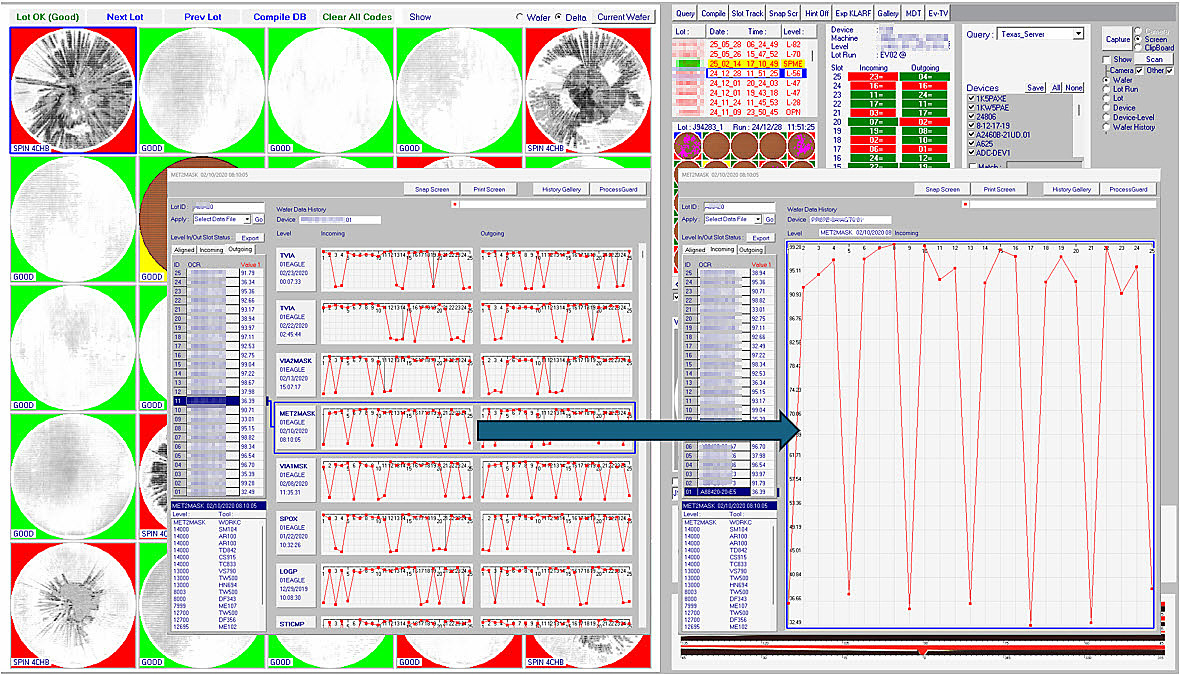
Fig. 3: In this example, a spin defect affected every fourth wafer (4-channel slot positional signal).
If a fab has not randomized wafers, but then needs to investigate a problem, usually it has to set up a new Design of Experiment and Special Work Request. Additional operators and engineers then have to go to work randomizing wafers and keeping track of slot positions – all of which require additional resources, cycle time, and wafer handling. And then, after weeks or months, the newly randomized wafers in the test lot might not even show the problem being investigated.
A better way to do this is to randomize all wafers and precisely track every wafer slot position. This means that every wafer automatically becomes a useful test vehicle, so there is no need to set up new DOEs. Whenever problems are seen (multiprobe, testprobe, or other testing), the wafers have already been randomized and are ready for slot positional analysis.
Microtronic’s EAGLEview can automatically randomize all wafers and precisely track every wafer slot position, and it can be turned on and off as needed. Moreover, where an existing randomization strategy is in place, it can be readily integrated to provide further partitioning capability.
 |
 |
 |
 |
 |
 |
 |  |
 |  |
 |
 |


Leave a Reply