
The gap between lab measurements and real-world applications can lead to suboptimal socket selection and hidden quality risks for customers.

As semiconductor devices continue to advance, the demand for reliable, high-performance test sockets has never been greater. Yet, traditional socket design validation methods—such as per-pin characterization and generic housing evaluations—often fall short of reflecting true application specific system-level performance. This gap between lab measurements and real-world application not only limits socket performance insight but can also lead to suboptimal socket selection and hidden quality risks for customers.
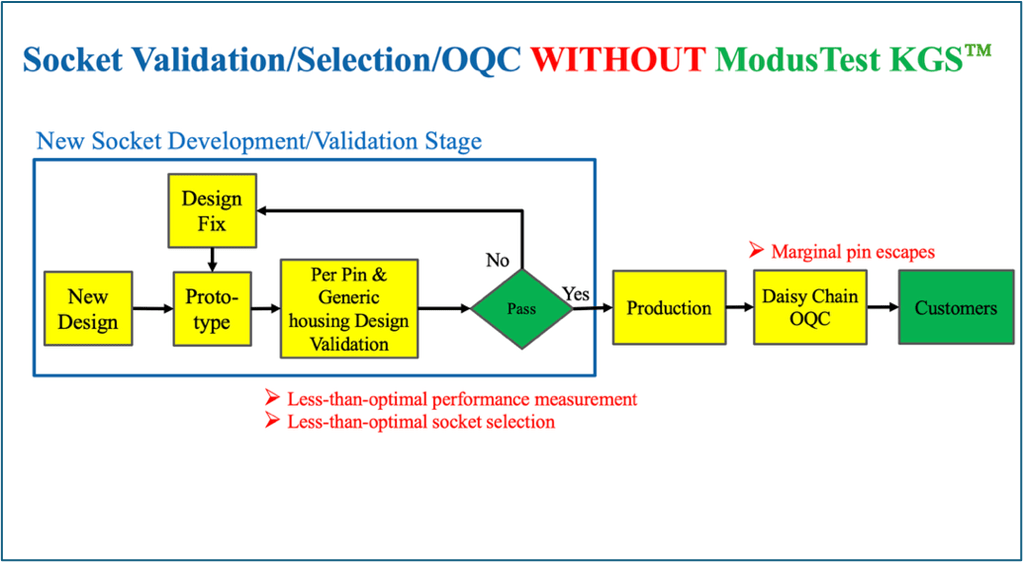
Most socket manufacturers use per-pin characterization and generic housing design validation to measure the performance of the new sockets. However, this doesn’t accurately represent the actual system-level characteristics of the socket in its application, resulting in less-than-optimal socket performance measurement and socket selection for the customer’s application.
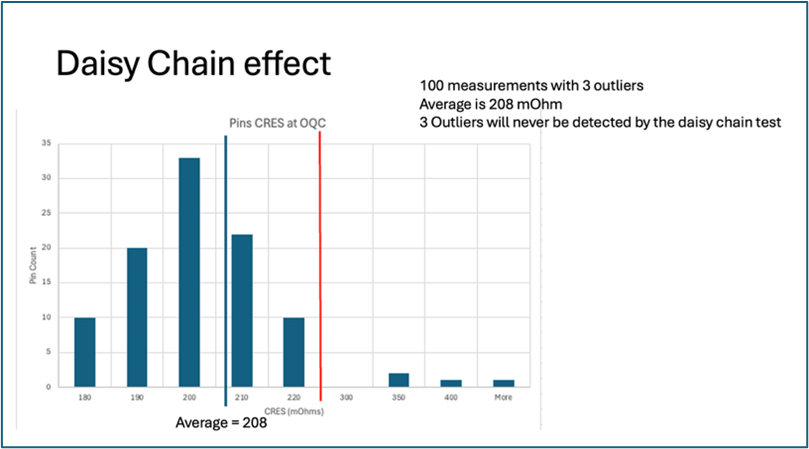
The graph displays a histogram of 100 measurements, including three outliers, which yields an average measurement per pin of 208 milli-ohms. With the upper spec limit set at 250 milli-ohms, three outliers will never be detected by the outgoing quality test, resulting in marginal pins being delivered to end customers.
Let me explain how the Modus Test Known Good Socket process, using the MPT and MTC, can improve the situation.
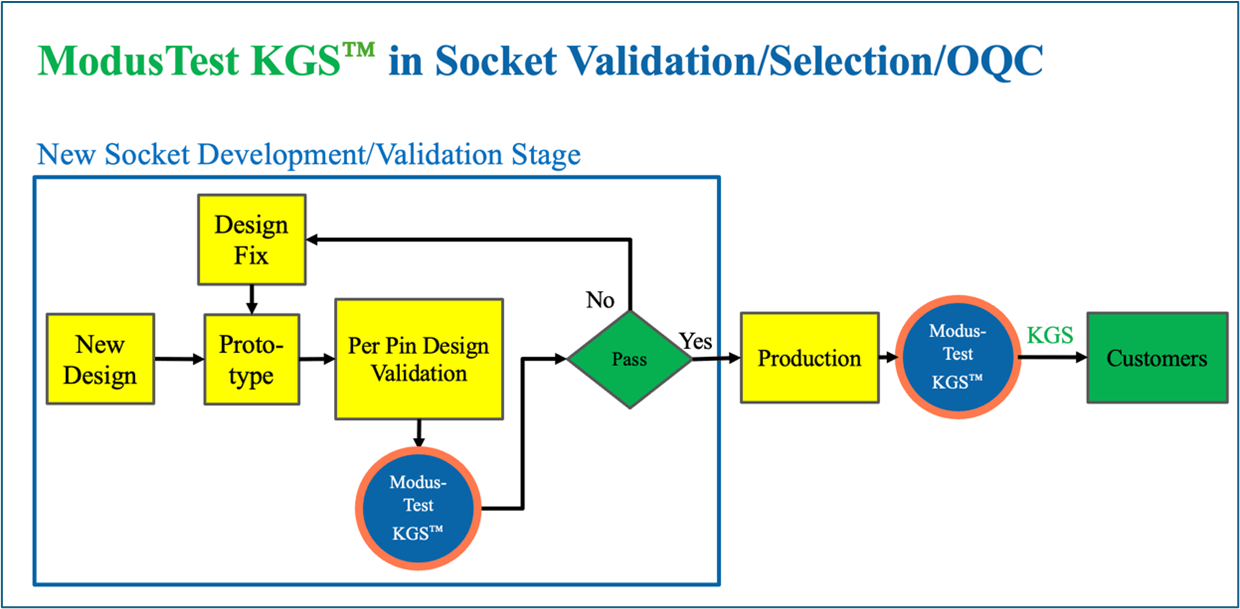
First, it allows you to validate your socket in an application-specific housing at the system level, which is precisely the same way your customer would use the socket in the end application.
Second, with the help of MTC, you can perform life cycle tests to monitor the performance over millions of controlled insertion cycles without having to use the production setup. The details on this will be explained in another blog post.
Third, with the help of MTC, which has a 1 micron displacement accuracy, you can perform an FDR study to measure the actual working distance of the pins at a system level, which is typically different from the per-pin FDR characteristics. Once again, the details on this will be explained in another blog post.
You can also use MPT and MTC to perform per-pin CRES measurements to screen out any outliers during your Outgoing Quality test, thereby ensuring only known good sockets are delivered to your customers. The graph displays the same set of data from the previous example, efficiently screening out the outliers with the same upper spec limit set for the test.

As the complexity of semiconductor devices continues to grow, so too does the need for test sockets that deliver both accuracy and reliability at the system level. Traditional validation methods, while useful for basic characterization, leave critical performance gaps that can result in hidden risks for end customers. By leveraging application-specific validation and system-level per-pin OQC with tools like MPT and MTC, manufacturers can not only identify outliers more effectively but also ensure that only known good sockets reach the market. This approach transforms socket validation from a laboratory exercise into a true reflection of real-world performance—delivering greater confidence, consistency, and value for both manufacturers and customers alike.
Learn more:
 |
 |
 |
 |
 |
 |
 |
 |
 |
 |


Leave a Reply