
Adaptive optimization algorithms promise better results and deeper insight into why certain designs perform better than others.

In the fast-evolving field of electronic systems design, engineers are under increasing pressure to deliver innovative, high-performance products within ever-shrinking development cycles. Traditional methods—relying on intuition, trial-and-error testing, and even basic simulation—struggle to keep pace with the growing complexity of modern systems. Nowhere is this more evident than in printed circuit board (PCB) design, where engineers must simultaneously balance performance, cost, and manufacturability. To meet these multidimensional challenges, a new generation of techniques has emerged, rooted in intelligent design space exploration and optimization.
To understand the need for optimization, one must start by tracing the evolution of engineering design from basic simulation to advanced single- and multi-objective optimization strategies. This article will explore the challenges inherent in modern PCB design, the inadequacies of legacy approaches, and the emergence of adaptive algorithms such as SHERPA and MO-SHERPA that promise not only better results but also deeper insight into why certain designs perform better than others.

Engineering design has always been iterative. For many years, engineers relied on manual methods—adjusting parameters one at a time, simulating or testing, observing the results, and repeating. This trial-and-error approach, while workable for low-dimensional problems, quickly becomes inefficient and error-prone as systems increase in complexity. In a design space involving several or more interdependent variables, human intuition and brute-force experimentation alone are insufficient to ensure success.
The rise of simulation tools marked a significant shift. By enabling virtual testing of signal integrity, thermal behavior, and electromagnetic performance, simulation has become a cornerstone of the modern design process. Yet, while simulation reduces reliance on physical prototypes, it does not inherently drive a design toward optimal performance. Running thousands of simulations may reveal how a design behaves, but without a strategic search framework, it remains difficult to identify the best possible combination of parameters. This is the fundamental difference between simulation and optimization: simulation evaluates, while optimization actively explores and exploits.
As design challenges intensified, the need to transition from simulation-driven to optimization-driven methodologies became clear. PCB design flows now require incorporating optimization algorithms capable of guiding this search through vast and often nonlinear design spaces. This approach transformed simulation from a validation tool into a vehicle for innovation.
To effectively implement optimization in engineering workflows, it is important to understand its foundational structure. Optimization problems are defined by three core elements: objectives, variables, and constraints.
Objectives represent the design goals—such as minimizing impedance or reducing overall cost. Variables are tunable parameters to achieve the goal—for example, trace width, via size, or material selection. Constraints define the feasible design space by imposing limits on variables or outputs—such as ensuring impedance stays within a specified range or enforcing manufacturing limitations.
Early attempts to apply optimization in engineering design often took the form of parameter sweeps. Engineers would systematically vary input parameters and observe the effects. While useful in low-dimensional spaces, this method becomes impractical as the number of combinations grows exponentially. More sophisticated techniques are required to intelligently explore large design spaces and avoid wasteful evaluations.
This has led to the development and adoption of formal optimization algorithms, which use mathematical and experimental methods to strategically navigate the design space. These algorithms offer a scalable alternative to brute-force methods and provide the analytical power needed to handle complex, real-world design problems.
In many engineering scenarios, especially during early design stages, a single dominant objective may emerge—such as minimizing impedance variation or maximizing power delivery efficiency. Single-objective optimization (SOO) seeks to find the best solution for that single target, subject to all relevant design constraints.
Numerous optimization algorithms have been adapted for SOO problems in PCB design. Genetic algorithms (GA), for instance, draw inspiration from natural evolution. They begin with a diverse population of potential solutions and use mechanisms like selection, crossover, and mutation to evolve high-performing designs over successive generations. GAs are particularly effective for discrete-variable problems, such as optimizing via placement or component selection, and are commonly used in early-stage PCB layout design.
Another popular technique is particle swarm optimization (PSO), which simulates the social behavior of flocks or swarms. In PSO, each candidate solution—called a particle—adjusts its position in the design space based on its own experience and that of its neighbors. This method is especially useful for optimizing continuous parameters, such as trace geometries or impedance tuning elements.
Bayesian optimization (BO) takes a model-based approach. It builds a surrogate model of the objective function using a limited number of simulations, then uses that model to guide further exploration. Because BO minimizes the number of simulations required, it is ideal for high-cost problems where each simulation run is time-consuming or computationally intensive.
Stochastic gradient descent (SGD), a staple of machine learning, is a gradient-based technique that adjusts parameters in the direction of steepest descent. While less common in PCB design due to the black-box nature of most simulation models, SGD can be valuable when applied to surrogate models or analytical approximations of physical behavior.
Each of these methods brings specific strengths to different problem types. However, their effectiveness depends heavily on the nature of the design space and the accuracy of underlying models. Choosing the right method, and applying it at the right time, requires experience and deep optimization understanding—and this is where SHERPA enters the picture.
Recognizing that no single algorithm performs best in all scenarios, Siemens developed SHERPA (simultaneous hybrid exploration that is robust, progressive, and adaptive), a hybrid optimization engine used in their optimization software, HyperLynx Design Space Exploration (DSE). Rather than relying on a fixed strategy, SHERPA dynamically blends multiple methods—such as genetic algorithms, particle swarm optimization, and surrogate-based modeling—during a single optimization run.
The SHERPA framework monitors the progress of each contributing method and allocates computational resources to the ones most effective at a given stage of the search. If the design space is smooth and continuous, SHERPA may favor gradient-based strategies. If the space is discontinuous or highly constrained, it may shift toward evolutionary or surrogate-based methods.
This adaptability is critical in PCB workflows, where the mix of continuous and discrete variables, high-cost simulations, and design constraints makes optimization difficult to navigate using traditional techniques. SHERPA also reduces the number of simulations needed by incorporating surrogate models, which predict outcomes based on prior simulation data. These predictions are refined as more data becomes available, further accelerating convergence toward optimal solutions.
Perhaps most importantly, SHERPA minimizes the need for manual algorithm selection or tuning. Engineers can initiate optimization runs with minimal setup and achieve expert-level performance, even if they are not familiar with the intricacies of each underlying algorithm.
While single-objective optimization is valuable, it can be insufficient in practice. Real-world engineering problems typically involve trade-offs between competing performance criteria. In the context of PCB design, these scenarios are common when balancing via count and impedance deviation in high-speed digital layouts or managing thermal constraints alongside layout compactness in power electronics. In such cases, it is not enough to optimize a single metric.
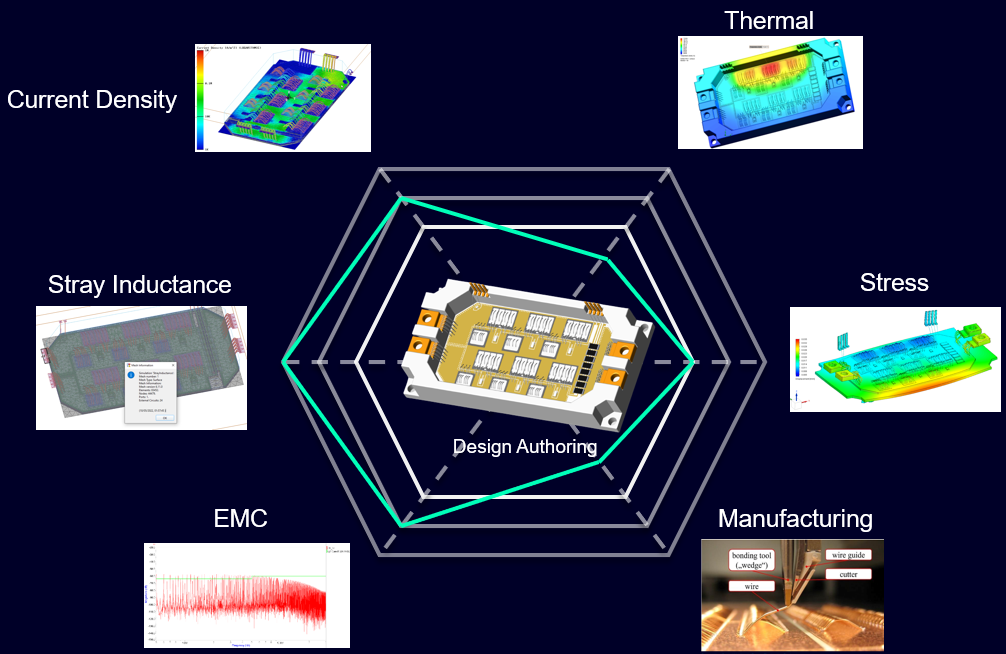
Optimal design often requires consideration of multiple objectives and domains.
Multi-objective optimization (MOO) addresses these challenges by optimizing several objectives concurrently. Rather than producing a single best solution, MOO generates a set of Pareto-optimal solutions—each representing a unique trade-off where improving one objective would worsen another. This Pareto front provides engineers with a visual and analytical framework for navigating complex design decisions.
A number of MOO algorithms have been developed for this purpose. The Non-dominated Sorting Genetic Algorithm II (NSGA-II) uses evolutionary techniques to classify candidate solutions into Pareto fronts and preserve diversity across those fronts. The Strength Pareto Evolutionary Algorithm 2 (SPEA2) enhances this process by maintaining an external archive of elite solutions and using density estimation to guide selection.
Other algorithms, such as the Multi-Objective Evolutionary Algorithm based on Decomposition (MOEA/D), break the optimization problem into smaller sub-problems, each representing a weighted combination of objectives. Multi-Objective Particle Swarm Optimization (MOPSO) and the Multi-Objective Covariance Matrix Adaptation Evolution Strategy (MO-CMA-ES) apply swarm intelligence and probabilistic modeling, respectively, to explore trade-offs and adapt search behavior over time.
Each method has its niche. Some are better suited for smooth, continuous landscapes, while others handle discrete or noisy spaces more effectively. In PCB design, algorithm selection depends on whether the design variables are analog or digital, the dimensionality of the problem, and the degree of objective conflict.
To simplify the application of MOO in complex engineering environments, Siemens extended its SHERPA framework into MO-SHERPA, a multi-objective optimization engine that automatically adapts to the evolving demands of the design space. MO-SHERPA combines strategies from leading MOO algorithms—such as NSGA-II, SPEA2, and MOEA/D—and monitors their effectiveness in real time.
As optimization progresses, MO-SHERPA identifies patterns in performance trends, surrogate model predictions, and the distribution of non-dominated solutions. Based on these insights, it adjusts its strategy to prioritize exploration, local refinement, or diversity maintenance, depending on the problem’s current state.
This capability is particularly valuable in high-dimensional, highly constrained PCB designs, where performance trade-offs can shift rapidly. For example, when optimizing a stackup in a high-speed digital layout with simultaneous constraints on signal integrity, delay, and power integrity, MO-SHERPA can begin by broadly exploring the space using global search techniques, then focus on fine-tuning viable solutions as it converges toward the Pareto front.
The result is a design process that not only identifies strong candidate solutions but also reveals how and why those solutions succeed. Engineers can use this insight to make informed trade-offs, justify design decisions, and communicate options to stakeholders with confidence.
The evolution from trial-and-error to structured simulation and now to intelligent optimization represents more than just a methodological shift. It reflects a deeper transformation in how engineers think about design. Relying on swept parameter analysis alone is becoming more impractical as designs and technology advance to multi-dimensional factors with massive design spaces. But with tools like SHERPA, MO-SHERPA, and HyperLynx DSE, they can explore a full spectrum of design possibilities, backed by data, insight, and confidence.
Optimization in PCB design is no longer about finding a good answer; it’s about understanding why it’s good, and how it compares to everything else. That is the power of optimization, and that is the future of intelligent design.
You can learn more about optimization and how the SHERPA and MO-SHERPA advantage can deliver a better design faster in our new three-part whitepaper series, From Simulation to Optimization. The first paper explains just why we optimize. The second paper shares a perspective on single-objective optimization strategies, and the series culminates with how to advance PCB design through multi-objective optimization.
 |
 |
 |
 |
 |  |
 |  |
 |  |


Leave a Reply