
The invisible foundation that ensures modern high-performance computing systems operate with speed and precision.

When thinking of AI, images of futuristic robots or self-driving cars may come to mind. What might not come to mind are the unsung hardware component heroes that are quietly enabling such complex systems. Among these, PCI Express (PCIe) switches might seem to be a boring topic to write about, much less read. But here’s the twist—they are nothing short of revolutionary when it comes to empowering AI workloads. Far from just a functional piece of hardware, PCIe switches are the invisible foundation that accelerates data processing, eliminates bottlenecks, and ensures modern AI systems operate with blazing speed and pinpoint precision.
PCIe switches are intelligent, multi-port devices that serve as the backbone of scalable, high-performance computing systems. Architecturally, a PCIe switch includes one upstream port connected to the root port and multiple downstream ports (connected to endpoints like GPUs, SSDs, or FPGAs). Internally, it features a non-blocking crossbar switch fabric, routing logic, non-transparent bridge (NTB) with cross-link feature for inter-domain communication, and telemetry.
What makes PCIe switches indispensable in AI and data center environments is their ability to scale connectivity and bandwidth beyond what a CPU’s root complex can offer. For example, modern PCIe switches enable direct peer-to-peer communication between endpoints—critical for multi-GPU AI training workloads where accelerators must exchange large datasets without CPU intervention.
PCIe topologies define how devices are interconnected in a system. The most common topologies include:
PCIe switches enable these topologies by acting as the central hub that routes traffic efficiently between devices, allowing for flexible system design and expansion.
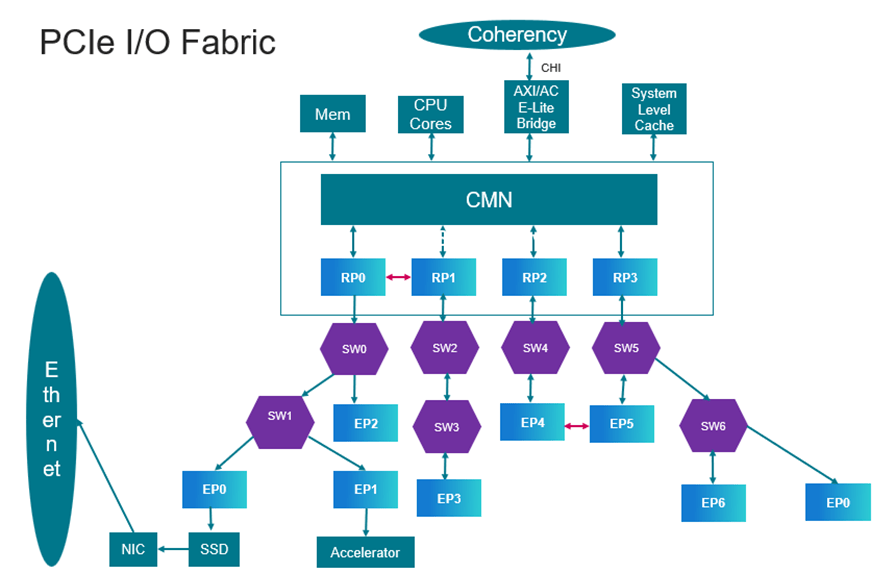
In short, while root ports and endpoints are fixed-function roles in a PCIe topology, the switch is the dynamic enabler that brings scalability, flexibility, and performance optimization with minimal latency. This capability is especially critical in AI-driven systems, where efficient data movement is key to overcoming bottlenecks.
By nature, AI systems are built to have immense streams of data, whether for training machine learning models, running neural networks, or performing real-time analysis. To achieve this, processors like CPUs, GPUs, and FPGAs must exchange data at incredible speeds. That’s made possible by PCIe, providing a high-speed, low-latency communication protocol. Yet, as AI applications demand more hardware integration and higher data throughput, standard PCIe links alone can’t keep up. This is where PCIe switches shine—delivering scalable, dynamic connectivity that quietly powers the performance of AI behind the scenes.
Unlike traditional switches, PCIe switches were designed to meet the unique demands of complex systems. These switches manage data flow between components, balance workloads, and ensure seamless communication, which allows AI systems to perform reliably under increasingly demanding workloads. What used to be a niche component is now something that industries can’t build AI systems without.
PCIe switches might not be as glamorous as shiny new AI algorithms or groundbreaking robots, but they do more heavy lifting than you might think. They’ve quietly become the hidden drivers behind AI transformations in areas like autonomous vehicles, healthcare diagnostics, and edge computing. The next time you hear “PCIe switches,” don’t think boring—think of them as quietly powering the greatest advances in AI, making them anything but ordinary.
Cadence delivers a robust PCIe switch with upstream and downstream ports, streamlining even the most complex serial link and protocol layer requirements. Our switch ports feature abstracts the intricacies of the PHY, data link, and transaction layers—freeing designers to focus on innovating at the application layer of their SoC fabric. This includes integration of endpoints, additional switches, and peer-to-peer (P2P) interconnects. Whether you’re architecting a dense interconnect topology or scaling PCIe connectivity beyond your SoC boundary, Cadence simplifies the heavy lifting—enabling agility, efficiency, and advanced design flexibility.
 |
 |
 |
 |
 |  |
 |  |
 |  |


Leave a Reply