
A robust OBGA packaging solution for automotive-grade reliability.

By WonBae Bang, KiDong Sim, Weilung Lu, and Adrian Arcedera
Advanced Driver Assistance Systems (ADAS) are increasingly adopted by automotive manufacturers to enhance driving safety. These systems help drivers in the driving process, thereby increasing car and road safety. ADAS technologies include features such as adaptive cruise control, lane departure warning and automatic emergency braking. As the automotive industry evolves, the integration of ADAS is becoming more prevalent, paving the way for a market boom in sensor technologies.
Optical sensors, including cameras, image sensors, and LIDAR components, play a critical role in ADAS. These sensors are essential for detecting and interpreting the environment around the vehicle, providing crucial data for the ADAS to function effectively. As autonomous driving technology advances from Level 2 towards Level 4/5, according to the Society of Automotive Engineer’s (SAE’s) SAE J3016 ranking system, the number of cameras per vehicle is expected to increase significantly, potentially exceeding 8 to 10 cameras per vehicle.
However, current packaging methods for automotive image sensors face several challenges. One primary issue is the mismatch in the coefficient of thermal expansion (CTE) between different materials used in the packaging. This problem becomes more pronounced as image sensors continue to increase in resolution and pixel count, leading to larger sensor chips, and consequently larger package sizes. The CTE mismatch can cause significant stress during thermal cycling, potentially leading to reliability issues such as glass cracking and delamination. Additionally, the current standard packaging methods have been proven reliable but cannot be efficiently scaled up to meet the increasing demand for sensors per vehicle.
To address these challenges, this study introduces a new optical ball grid array (OBGA) package structure that leverages molding and lid placement technologies for microelectromechanical systems (MEMS) and sensor devices. The new OBGA package offers an alternative package solution, provides a robust package structure and anticipates larger sensor size requirements.
The development of the new OBGA package involves several key steps. First, thermomechanical modeling is used to analyze package configuration and demonstrate the robustness and reliability of the new package. This modeling helps to identify potential issues related to CTE mismatch and glass cracking, allowing for the optimization of the package design. The new package also incorporates a glass lid instead of metal or liquid crystal polymer (LCP) lids, eliminating venting holes to prevent particle contamination on the sensor area.
The new OBGA package combines the professional value proposition of outsourcing assembly and test by utilizing cavity MEMS experiences and leverages its high-end consumer digital camera product line management experiences. This combination results in a package that is not only reliable but also implements Design for Manufacturing (DFM), meeting the performance and reliability requirements of the automotive industry for new package structures (see Figure 1).

Figure 1. New Package Structures.
This paper focuses on glass-on-mold (GOM) structure development. For automotive CMOS image sensor (CIS) package level reliability, typically referred to in the Automotive Electronics Council (AEC) AEC-Q100 specification, the new package must endure stress conditions for automotive grade qualification. The development follows a system of advanced product quality planning (APQP) by technology development methods to overcome mechanical failure of package (see Figure 2).

Figure 2. Mechanical failure of package.
In this study, solutions such as package configuration, material selection and process optimization have been evaluated to accomplish to control vapor outgassing and optimize the glass attach process parameters to improve the OBGA package.
The experimental phase of the study involved simulating various package configurations and materials to optimize the OBGA package. The feasibility study focused on several key parameters, including glass attach process parameters, water infiltration, bond line thickness (BLT) and glass tilt. These parameters were evaluated through a series of design of experiments (DOE) and simulations.
P = Pressure of gas
V = Volume of GasT = Temperature of gas
N = Number of moles
kB = Boltzmann constant
Several equations were used to guide the design process, including Boyle’s law, Charles’s law and Gay-Lussac’s law. These laws help to understand the relationship between pressure, temperature and volume, which are critical for designing the cavity volume and controlling the process temperature. For the connection between Gay-Lussac’s law of pressure-temperature, Boyle’s law and Charles’s law see Figure 3.

Figure 3. Relationships between Boyle’s, Charles’s, Gay-Lussac’s, Avogadro’s laws.
The first step in the experiment was to identify preliminary design rules and package configurations. This involved creating study legs to run simulations and narrow down the package development scope. The simulations considered factors such as bond line thickness of the glass adhesive, contact width of glass and glass adhesive material selection

Table I. Simulation DOE 1 parameters.
The simulation analyzed stress and design factors, such as the bill of materials and levels. The preliminary package configuration was reviewed based on the end application requirements shown in Table I, and a simulation DOE was conducted to evaluate different package sizes, glass adhesive materials and bond line thickness levels illustrated in Table II. Table II. Simulation DOE 1 study legs.
The simulation tool is a 3D quarter finite element (FE) model, where all of the materials are assumed to have temperature-dependent linear elasticity and stress, referring to the package model in Figure 4.

Figure 4. Perspective view of package.
Two major weak points were defined. First is the interface between glass and glass adhesive layer, which main focus on the glass stress to cause delamination. It denotes S1 and Interface 1 as shown in Figure 5.a. Second is the stress between the mold and solder resistance on the substrate, the interface denoted as S2 and Interface 2 in the model shown in Figure 5.b.

Figure 5. (a.) Glass stress interface and (b.) solder resistance interface.
The simulation results on glass stress S1 reveals: thicker glass adhesive, a wider contact width reduces glass stress and insignificant difference between two glass adhesive materials as shown in Figure 6.
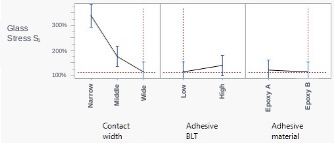
Figure 6. Glass stress (S1) simulation results.
Simulation results on solder resistance (SR) S2 show: it has a similar tendency to predict wider contact width that reduces glass stress, and Epoxy A has better stress results than Epoxy B (see Figure 7).
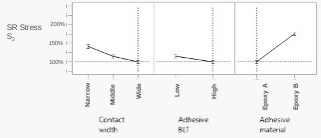
Figure 7. Solder resistance stress (S2) simulation results.
Since the glass adhesive shows different outcomes for glass stress S1 and solder resistance S2 stress, the BLT will go through feasibility studies to determine the specification.
The DOE for feasibility studies is based on simulation data to determine middle and wide glass contact widths, the BLT setup with low level for Epoxy A and low & high level for Epoxy B according to material properties providing a four-leg matrix study. The assembly process flow is shown in Figure 8.

Figure 8. OBGA package assembly process flow.
The studies determined certain process optimizations such as die attach, wire bonding, solder ball attach, and package singulation as a standard ball grid arrange package. For example, wire bonding results are shown in Figure 9.

Figure 9. OBGA wire bond process.
The key process is glass attach and where three major metrics, water infiltration, bond line thickness (BLT), and glass tilt were evaluated to seal the cavity, protect sensor component and fulfill flatness for optical requirements. The DOE results are shown in Table III. Note there is a significant failure for Leg 1 that encountered water infiltration (see Figure 10).

Table III. Feasibility DOE and test results.

Figure 10. Water infiltration for Leg 1.
To consider package configuration and smaller package size, Leg 2 was determined to continue further reliability test, shadow moiré measurement and establish preliminary design rules and bill of material for new package platform.
D. Warpage Measurement
Since the OBGA package is a Surface Mount Device (SMD) component, it is critical to verify warpage performance to ensure compatibility with the reflow process. Shadow moiré measurements were conducted to analyze the warpage behavior at different temperatures, as shown in Figure 11. The results indicate that warpage shifts between convex (cry) and concave (smile) profiles across varying thermal conditions. Maintaining package coplanarity is essential for reflow soldering reliability. The warpage data suggests that the optimized OBGA structure meets industry reflow standards. Results are shown in Figure 11.

Figure 11. Shadow moiré for Leg 2.
The reliability testing phase involved subjecting the optimized OBGA package to a series of tests to evaluate its performance under various conditions. The tests included temperature cycling (TC), high-temperature storage (HTS), thermal and humidity stress, and unbiased highly accelerated stress test (UHAST).The TC test subjected the package to two conditions: a temperature range from -55°C to 125°C (TCB) and from -55°C to 150°C (TCH), each for 1,000 cycles. This test evaluates the package’s ability to endure thermal expansion and contraction without compromising its integrity.
The HTS test involved storing the package at 150°C for 1,000 hours and extending it to 2,000 hours. This test evaluates the package’s ability to withstand prolonged exposure to high temperatures without experiencing degradation or failure.
The thermal and humidity stress test involved exposing the package to 85°C and 85% relative humidity for 1,000 hours after Moisture Sensitivity Level 3 (MSL3) pre-conditioning. This test evaluates the package’s ability to withstand combined thermal and humidity stress conditions.
UHAST was conducted under conditions of 130°C and 85% relative humidity for 96 hours, with an extension to 192 hours. This test assesses the package’s ability to endure prolonged exposure to these extreme conditions without degradation or failure.All samples passed the reliability tests, demonstrating the robustness and performance of the optimized OBGA package. The package showed no significant degradation or failure, confirming its suitability for automotive applications (see Table IV).

Table IV. Reliability results for Leg 2.
In addition to the reliability tests, the package robustness was verified through ink penetration and glass shear tests. These tests evaluate the package’s ability to withstand mechanical stress and maintain its integrity.
The ink penetration test involved applying ink to the package and evaluating its ability to prevent ink from penetrating the sealed cavity. The results showed no ink penetration for fresh units and post-preconditioning MSL3, as well as at the end of the read point of UHAST, TCB, and HTS (refer to Figure 12).

Figure 12. Ink penetration results for Leg 2.
The glass shear test involved applying shear force to the glass lid and evaluating its ability to withstand mechanical stress without experiencing delamination or failure. The results showed no significant degradation and met minimum specification of 3.5kgf after preconditioning MSL3, UHAST, and HTS, confirming the robustness of the glass attach process (see results in Figure 13).

Figure 13. Glass shear test for Leg 2.
The new OBGA package offers a reliable solution for automotive optical MEMS and sensors, addressing the challenges of existing packaging methods. Its effectiveness has been demonstrated through a series of experiments, simulations and reliability tests. The optimized package provides a large body size capability and efficient manufacturing while maintaining the necessary performance and reliability requirements for automotive applications. This innovative packaging solution addresses the current and future demands of ADAS and autonomous driving technologies.
[1] Automotive Electronics Council, “AEC-Q100 Rev J: Failure Mechanism Based Stress Test Qualification for Integrated Circuits,” Automotive Electronics Council, 2023.
[2] Han, S. F., Yang, D. G., Cai, M., Liu, D. J., and Nie, Y. Y., “Thermal modeling and analysis for a novel packaging structure of CMOS image sensor,” 2016 17th International Conference on Electronic Packaging Technology (ICEPT), 2016, pp. 1174-1179.
[3] Society of Automobile Engineers (SAE), “Taxonomy and Definitions for Terms Related to Driving Automation Systems for On-Road Motor Vehicles,” 2021.
[4] Teoh Eng Kang, et al., “CMOS image sensor packaging technology for automotive applications,” 2019 iMAPS MiNaPAD.
[5] Wang, Yao; Qin, Fei; Ma, Shuying; Wang, Jiao; Xiao, Aimo; Zhao, Shuai, “Process development of 3D WLCSP for ultra-thin CMOS image sensor,” 2020 21st International Conference on Electronic Packaging Technology (ICEPT), 2020, pp. 1-4.
[6] Zheng, Dan; Yang, Daoguo; Chen, Kun; Chen, Xindon; Zhang; Yuhang; Li; & Xiaojun, “Analysis and Optimization of the Packaging Process for Supper Large-size CMOS Image Sensor,” 2022 23rd International Conference on Electronic Packaging Technology (ICEPT), 2022, pp. 1-5.
 |
 |
 |
 |
 |
 |
 |  |
 |  |
 |
 |


Leave a Reply