
The EV revolution relies on battery innovation, while AI data centers need a range of new energy solutions to play nice with the grid. Both sectors are taking notes.

Key Takeaways:
AI data centers and automotive companies are converging on the same energy-related problems from different angles, but they are leveraging technology improvements developed by each other to accelerate the timetable for solutions.
Both share a common goal of obtaining more energy. For AI data centers, this is a function of insatiable demand for compute power, which is needed to shorten time to results with greater accuracy. For smart cars, which increasingly resemble data centers on wheels, it’s a matter of adding more compute-intensive intelligence and, in the case of EVs, improved range per charge.
Yet both are running into the same limitations. Power grid capacity isn’t increasing nearly as fast as demand for energy, and the technology needed to significantly improve efficiency takes time to develop. At the same time, each is encountering increased costs and political pressure stemming from rising utility rates.
The solution comes in three parts:
Bi-directional charging is available in some vehicle models today, and it has been gaining traction as an inexpensive way of storing excess energy collected by solar panels and wind farms. Early battery storage farms utilize batteries that are considered end-of-life for vehicles because they have insufficient capacity for BEV range, but they are still useful for other applications. On top of that, battery prices have been dropping due to increased competition and new battery chemistries, which are driving new battery sales.
“As batteries become much less expensive, the growth of battery energy storage systems (BESS) will continue in a big way,” observed Peter Wawer, division president of green industrial power at Infineon. “It’s estimated that data centers will, at a point in the future, overtake total consumption compared to the automotive market.”
An ESS, comprised of thousands of batteries managed by a battery management system, can be used as backup if the grid goes out or even voltage fluctuations, and as the main power source during peak grid times.
“AI data centers are a different beast than typical data centers,” said Sinha Puneet, senior director and global head of battery at Siemens EDA. “There are two key differentiators between a normal data center, which has been there for the last 15-plus years, versus the new AI data centers. AI data centers require a lot more joules, a lot more energy, because AI jobs are a lot more energy-consuming. Also, there is more fluctuation in energy demand for AI data centers — approximately 10X more fluctuations in energy demand compared to a regular data center — because as one AI job finishes, another comes in. If not managed correctly, fluctuation can brown out the whole grid. That’s why energy storage is extremely central for any AI data center’s operation, and that’s why you see all this massive new demand for better energy storage systems to provide that energy.”
To manage those fluctuations, fast-acting battery energy storage becomes critical, particularly if there is any disruption on the utility side. “ESS can provide energy for a few hours, but absorbing that fluctuation and providing the energy is extremely critical because these AI data centers require a lot of energy,” said Sinha. “In the U.S., you have a peak-time energy rate, which is very high. Increasingly, companies are looking at ESS to reduce their OpEx, especially the energy rate for them. They want to take away that peak-time energy consumption to batteries. A lot of normal battery energy storage systems today provide approximately one to four hours of operation. But companies are also looking at long-duration energy storage systems, such as what Google is trying to do with Form Energy, the flow battery company.”
Flow batteries are rechargeable energy management systems that store chemical energy in liquid electrolytes contained in external tanks. In the future, a longer-duration ESS will be essential to address another challenge, which is the difficulty and time-consuming process of connecting AI data centers to the grid.
“Grid connection is an extremely time-consuming process,” said Sinha. “The last I checked, you’re looking at a few years in many cases to have that connection, which is why many companies are talking about having on-site gas generators and other power options, because it takes so long for all the compliance and whatnot to obtain the grid connection. Behind the meter, companies are looking at whether they can have on-site energy generation, as well as exploring the use of long-duration energy sources from flow batteries and other technologies that can give them longer duration operation without waiting for the grid connection.”
Managing energy movement, particularly with a mixture of equipment, is non-trivial. “How do you move a lot of energy safely, efficiently, and intelligently between the grid, storage, and highly dynamic loads?” asked Hoa Tram, senior principal product engineer at Cadence. “EVs brought us high‑voltage battery packs, sophisticated BMS, and bidirectional power electronics for regenerative braking and vehicle‑to‑grid, governed by strict functional‑safety processes — and those ideas are now showing up in data centers through large‑scale battery energy‑storage systems, layered battery management, and smarter interaction with the grid.”
Sharing technology
What’s important to note here is the flow of ideas is not a one‑way street. Engineers across the electric vehicle and data center sectors are now exchanging ideas on how to optimize energy and battery use, and potentially feed excess power back to the grid in a symbiotic relationship.
“Hyperscale data centers are leaders in using telemetry, analytics, and digital twins to plan and operate complex infrastructure, and automotive OEMs and suppliers are adopting similar approaches for software‑defined vehicles, fleet‑level battery analytics, and power/thermal optimization,” Tram noted. “Cadence sits in the middle of that cross‑pollination — the same system‑level modeling, functional‑safety flows, and data‑center digital twins we provide for hyperscale customers are being used to design the next generation of automotive and energy systems, as well.”
On the flip side, some vehicles already return excess power via bidirectional energy systems, including vehicle-to-grid (V2G), vehicle-to-home (V2H), and vehicle-to-load (V2L).
“As vehicles become electric and connected, they become a moving energy asset on the road,” said Negar Soufi Amlashi, senior vice president of sales at Infineon. “They not only consume power, but they generate it, store it, and even feed it back to the grid. This symbiotic relationship becomes pivotal. This is a transformation, powered by semiconductors and software, enabling clean propulsion and efficient connectivity between vehicle and grid. Every single watt saved translates to value created.”
Devices at play here include bidirectional traction inverters, bidirectional on-board chargers, power modules, and solid-state charging stations, based on silicon, SiC, and GaN. “This enables a power conversion which is very efficient, helps reduce losses, and makes efficiency the new currency,” Amlashi noted.
AI-driven energy management makes the vehicle an essential part of the grid that can optimize power in real time. “The battery duration can be expanded by optimizing the usage of energy, which extends the range of the electric car,” said Amlashi. “Further, we enable an efficient integration of the vehicle to the grid, for example, by efficient bidirectional charging.”
With that in mind, many are asking whether data centers could achieve the same optimizations through battery energy storage systems, alternative sources of on-site power, or micro-DC grids.
“DC grids are already creeping in from the industrial side,” said Infineon’s Wawer. “Quite a few companies are equipping typical industrial manufacturing sites with DC grids, because the logic is very simple. You can connect consumers and gain battery storage through this kind of system, while massively increasing the efficiency. For example, today, industrial robots typically use resistors for braking. If you’re moving the arm and you have to slow it down, you brake, and you consume the energy via a resistor, which is totally inefficient. With the DC grid, you can change the topology, remove the resistor, and instead break by generation and feed the energy back into the grid — convert it like with the EV. If you break, it’s converted and fed into the battery. It opens up a huge variety of topics, including DC-fed generation, because you have some solar panels on the roof or close by. These things are already moving, slowly but steadily, in typical industrial style. That is massively being accelerated due to the AI data center guys jumping on it, so it nicely fits together.”
New materials and architectures
Cranking up the voltage in systems, rather than increasing the current, is another piece of the solution. That enables greater power density per given area, and less data movement, which is expensive in terms of resources and dollars.
Together, the semiconductor, automotive, and energy industries are exploring solutions at every layer of the stack so that cost per token remains affordable as the AI revolution continues at pace.
“We get a lot of push on density,” said Kristof Beets, vice president of product management at Imagination Technologies. “There is a push for getting as much out of the physical space, as well as the power budgets, that data centers and automotive have. But most of the push we get is very much from the efficiency point of view. That tends to be the other markets more than the server space — the server space is still a secondary consideration.”
However, this trend may soon reverse as power needs grow, and AI inference costs rise with a focus on intelligence per watt. That will require different architectures and materials.
According to a recent Morgan Stanley report on energy markets [1], “…investors noted that power suppliers and power equipment companies are likely to see benefits from data-center expansion, particularly among expectations that AI will unleash a productivity wave throughout the broader economy. This has investors focused on the rising demand for off-grid solutions, eliminating bottlenecks in the energy supply chain and using credit markets to finance energy system growth. While most sites also maintain their ties to the grid, investors expect to see more developers shift toward hybrid or off-grid models that let developers ensure the resilience of their operations in a tightening global power market, which places a higher focus on power equipment providers.”
That, in turn, requires new materials. “We are talking about power rails in the several thousands of amperes,” said Helmut Puchner, vice president and fellow, Aerospace & Defense, at Infineon Technologies. “This is scaling massively. The old power supplies were single-phase power supplies. You switch your transistor on and off. Now we are talking 12 or 16 phases. Gate drivers can handle 150 amps each, or more. SiC (silicon carbide) can cover more than 1,000V. GaN (gallium nitride) is in the medium-range voltage, and silicon can cover from 650 volts down to 10 volts.”
Wide bandgap materials such as SiC and GaN are enabling data centers to shift from a 48 V DC rack-level power architecture to 800V. “This is a big jump,” said Pradeep Shenoy, compute power technologist at Texas Instruments. “I liken it to the electric vehicle market, or vehicles in general. Today, you might have a 12V lead-acid battery. Some vehicles have 48V systems. If you look at EVs on the market today, they have batteries that are 400V or 800V. We’ve been working on that technology for quite a long time, so we’re able to quickly leverage a lot of technology around isolation or gallium nitride that was developed for other markets and apply it to data centers. Some of the architects and key leaders in the data center space will say they’re trying to borrow technology that’s already been developed for the electric vehicle market. 800V-based EVs are very common. They’re on the road today, and the infrastructure can be leveraged quickly.”
Data center vs. automotive battery management
Overseeing battery energy storage systems and energy management between the data center, grid, and renewable power sources is a hierarchy of AI-enabled software systems, including battery management systems (BMS), energy management systems (EMS), and grid-interactive UPS systems (GiUPS).
“There’s some level of energy management that’s happening at the data center, but there’s also going to be some level of coordination and communication with the power grid,” said TI’s Shenoy. “At a high level, it will be the data center and the grid interacting. But within a data center, there will be systems controlling how much power they pull from the grid, how much power they pull from local battery storage, or store power into it. There will be management at different levels.”
In both automotive and data center applications, the BMS monitors thermal input, hotspots, coolants, electrical controls, overcharging, or over-discharging.
“The thermal hydraulic cooling loop is often the most challenging,” noted Bryan Kelly, principal engineer at Synopsys. “This area of mechatronics typically falls outside the hands-on expertise of many hardware/software battery pack design engineers. Although CFD software tools can support preliminary ‘what if’ thermal analyses, ultimately a virtual prototype of the complete cooling system — cooling plate, piping, hoses, manifolds, and related components — is essential.”
Such a model enables verification across different coolant types or mixture ratios, environmental conditions, and operating scenarios, and allows results to be validated against measurement data. “In addition, an end-to-end thermal story of the battery pack simulation model makes it possible to study required heating at extremely low temperatures, evaluate HW/SW control behavior across wide temperature ranges, and simulate fault conditions — such as reduced coolant flow during high load current demand — that are difficult or impractical to reproduce on a physical test bench,” said Kelly.
Alternative and renewable sources of power
The last piece of the three-part solution involves a variety of energy sources to maintain constant, uninterruptible data center power.
“The only solution is to have an appropriate mix of power sources, meaning solar and wind. On shorter notice, it’s most likely gas turbines that are being made available,” said Infineon’s Wawer. “All other forms, especially if we think about nuclear, take much too long [to build]. If I need X, Y, Z terawatt hours, and you start building a nuclear power plant, let’s see when this will be ready. The requirements are much shorter term, and the short-term availability of energy can only be supplied by renewables, plus the combination of energy storage.”
Recommissioning existing nuclear plants is a faster solution. “I live in Pennsylvania, and they’re trying to reinstate the Three Mile Island nuclear power plant,” said Steven Lee, product manager of power electronics design software at Keysight Technologies. “They’re recommissioning it to power AI data centers that are coming everywhere. They’re going to continue to use the grid for distribution, but are going to rely on nuclear power to satisfy the energy demands. Electricity for you and for me, at our houses, is going to become a lot more expensive as a result of AI data centers. That will be the immediate effect for us.”
If regions do not already have nuclear, deploying solar is easier in terms of permit time, availability of solar panels, and installation. “The cost per kilowatt hour has reached a point below one cent per kilowatt,” said Wawer. “That alone should drive solar installations to be a large part of the solution going forward, to provide additional electricity as fast as possible.”
The conversion power sequence to get from solar panel to battery to data center or grid is the reverse of that of grid to gate. “Solar panels create DC (using photovoltaic cells),” said Lee. “Then you’re trying to go the other way and convert it into AC using a solar inverter. That’s why it’s called an inverter, because it’s DC to AC for solar, whereas it’s an AC to DC flow to get from the electric grid to the data center processors. It’s related, but backwards.”
The solar inverter can be placed before or after a battery, or both, depending on whether the system is AC-coupled or DC-coupled. The battery holds the DC charge, and then the inverter converts it to AC energy for the grid. The energy is then converted back to DC again via, for example, a two-stage 800V DC power architecture, to be used by the data center rack processors, Lee explained.
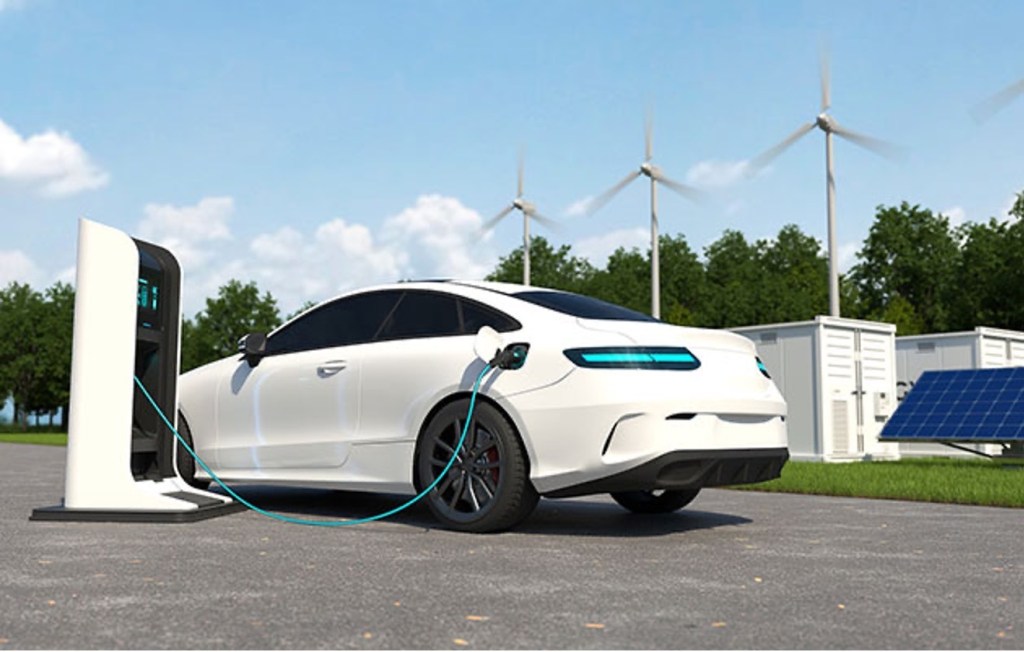
Fig. 1: An EV charging from a wind and solar powered energy storage system. Source: Cadence
EVs also leverage solar power, and are further along than data centers when it comes to potentially giving excess power back to the grid. For example, solar panels on the roof of a home can be connected to a Tesla wall unit. “It takes the DC solar power, charges the battery in that wall unit, then an inverter converts it to AC to charge the car or another appliance in your home,” said Keysight’s Lee. “Also, if the grid requires electricity from your house, because it’s short, then the power can go backwards into the grid, and then the grid can distribute that to someone else’s house, or a data center.”
It’s the same chain happening, no matter which way the power is flowing. “There’s a battery in the middle, and then instead of power coming from the grid, you could be putting it back into the grid,” said Lee.

Fig. 2: Challenges in modern power grids. Source: Infineon
Other options
Similar to existing home and EV models, a data center with on-site energy generation could theoretically give excess energy back to the grid. “It depends on what sort of timescales we’re talking about,” said TI’s Shenoy. “There are some microsecond-level spikes of power that a data center might have, in very short timescales, where the grid is usually operating on much lower, longer timescales, relatively speaking. Other concerns from the power grid perspective are, ‘What if this data center has fluctuations or disturbances and takes down the power grid?’ That would not be good, and there’s a lot of activity and engineering know-how focused on ensuring the data center operates in a way that plays nicely with the grid. Even if it isn’t necessarily sending power back to the grid, if it is behaving properly as a load to the grid, that would actually be a very good accomplishment.”
A simpler possibility is to feed excess heat from data centers back to local utilities companies, as seen recently in Scandinavia. [2] [3]
“Data centers are just converting energy, electrical energy, into heat, like any power plant or heating plant,” said Infineon’s Puchner. “I grew up in Austria, and for generations, we were burning garbage with extra fuel, and so you get rid of the garbage, and as a side product, you generate heat, which is distributed to 60,000 to 100,000 households. I can see that model being used, instead of heating the river by two or three degrees for data center cooling. Why don’t they give the heat back to the community? We can all use heat in winter.”
Heating nearby facilities is technically challenging, but possible. The real issue is cost.
“The systems exist. The technology is there. But the investment might be too high for data center companies,” said Puchner. “If the general public or governments are willing to spend that, it’s a good idea. Those data centers run 24/7 and generate a lot of heat.”
Repurposing innovations look set to grow, whether they are to take advantage of excess energy or heat, or to recycle old batteries and hardware. Two recent examples:
Conclusion: Why this matters
More efficient chip, network, and converter architectures are all part of the solution to help reduce AI data centers’ power consumption. The other side of the solution is to make use of cleaner, renewable sources of energy so that power used by AI data centers does not negatively impact the general population in terms of availability and cost.
Electric vehicles promise similar relief from reliance on limited oil supplies. However, it’s worth noting that depending on where a driver’s electric grid gets its power — from nuclear to hydro to coal — EVs are not necessarily a lot cleaner than gas-powered cars. “You are just looking at one very specific part of the timeline, which is my car, but you’re not looking upstream where the power comes from,” Keysight’s Lee noted.
References
[1] Energy Markets Race to Solve the AI Power Bottleneck (Morgan Stanley)
[2] Finland’s Data Centers Are Heating Cities Too (Bloomberg)
[3] DEN01 data center to supply heat to Danish homes (atNorth)
[4] A second life for EV batteries, clean energy for communities (Waymo)
[5] A low-carbon computing platform from your retired phones (UC San Diego, Google)
Related Articles
Chip Innovation Will Bridge The Gap For USA Data Center Power
GenAI demand is exponential; the US power grid can’t keep up; necessity spurs invention.
Environmental Sensors Catch More Data For A Greener World
New types of sensors can generate environmental data in real time using a range of tools, including flexible, printed ICs and AI/ML.
 |
 |
 |
 |
 |
 |
 |
 |


Leave a Reply